
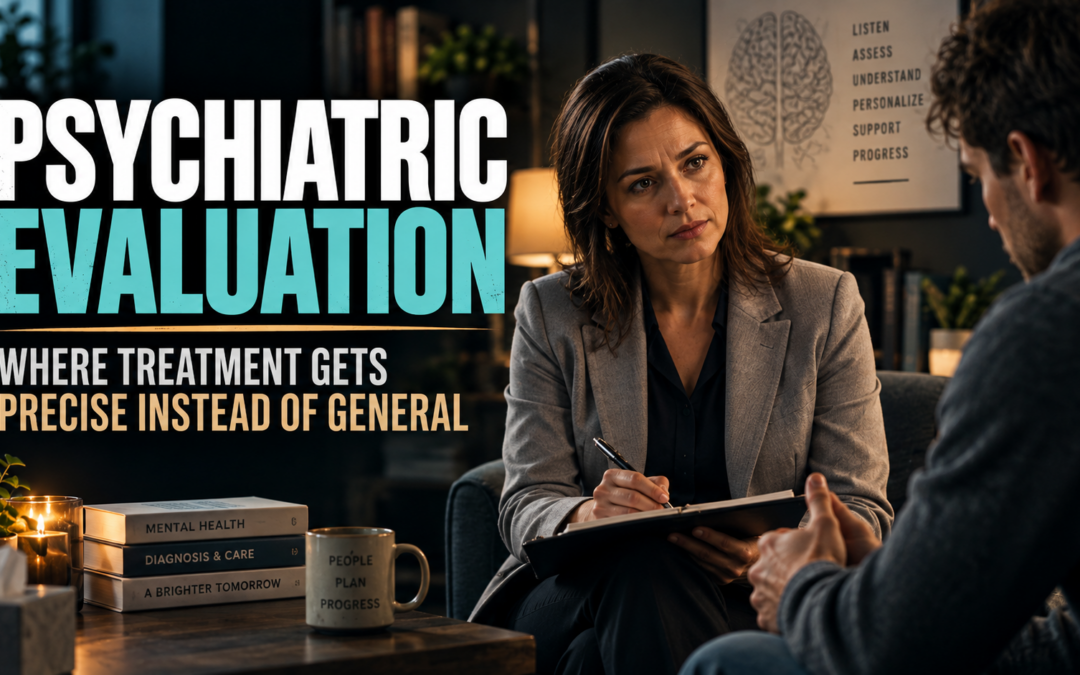
A psychiatric evaluation is a thorough assessment of your mental health, history and symptoms that helps a care team build addiction treatment around your actual needs. If you or someone you love has entered treatment before and felt like it never quite fit, this step is often the missing piece.
You may feel unsure about being evaluated, or worried about what it might reveal. Those feelings are understandable, and they do not mean anything is wrong with you.
The truth is that a careful evaluation replaces guesswork with clarity. Instead of applying a general plan to everyone, it helps a team understand what is really driving substance use. That precision can make a real difference in how recovery feels and how well it holds. Let’s look at what this step involves and why it matters so much.
What Is a Psychiatric Evaluation in Addiction Treatment?
A psychiatric evaluation is a structured conversation with a trained professional who assesses your mental health, substance use, medical history and personal goals. It gives a care team the full picture needed to design treatment that fits you rather than a generic template.
This evaluation looks at more than substance use alone. It explores your emotions, thinking patterns, past experiences and any mental health conditions that may be present.
Think of it as a careful map before a long journey. When a team understands where you are starting from, they can plot a clearer path toward where you want to go.
Who Needs a Psychiatric Evaluation?
Anyone entering addiction treatment can benefit from a psychiatric evaluation, especially those whose substance use may be linked to deeper struggles. It helps people who feel anxious, low or overwhelmed alongside their substance use.
It also serves people who have tried treatment before without lasting results. When a past plan missed an underlying condition, an evaluation can help explain why.
You do not need a specific diagnosis to deserve this step. If substance use has affected your life, a thorough evaluation can help care meet you where you are.
What Does the Evaluation Actually Involve?
A psychiatric evaluation involves a supportive conversation, not a test you can pass or fail. A professional asks about your symptoms, your history and how substance use has shaped your daily life.
You may be asked about your mood, sleep, relationships and any past mental health concerns. These details help reveal patterns that a single moment could never show.
The goal is understanding, not judgment. Every question connects back to building care that truly fits your situation.
Why Does a Psychiatric Evaluation Make Addiction Treatment More Precise?
A psychiatric evaluation makes addiction treatment more precise by uncovering the specific factors driving substance use in each person. Instead of treating addiction as one uniform problem, it reveals the unique story underneath.
Two people may struggle with the same substance for very different reasons. One may be coping with anxiety, while another may be managing the weight of past trauma.
When a care team understands these differences, they can tailor therapy, support and next steps accordingly. That precision helps treatment address the root, not just the surface.
How Does General Treatment Fall Short?
General treatment falls short because it applies the same plan to people with very different needs. A one-size-fits-all approach can overlook the conditions that shape a person’s substance use.
When care misses an underlying mental health condition, recovery often feels fragile. The substance use may pause, yet the deeper struggle keeps pulling a person backward.
A psychiatric evaluation closes that gap. It ensures the plan reflects the real causes rather than a partial view.
How Does Precision Support Lasting Recovery?
Precision supports lasting recovery by targeting the exact challenges a person faces. When treatment fits the individual, the tools and skills tend to hold up better in daily life.
A precise plan can address anxiety, depression, trauma or other conditions alongside substance use. Treating these together gives recovery a steadier foundation.
At Evolve Indy, care begins with understanding the whole person. Your history and goals shape the plan your team builds with you.
How Does a Psychiatric Evaluation Connect to Dual Diagnosis Care?
A psychiatric evaluation connects to dual diagnosis care by identifying whether a mental health condition and a substance use disorder are present at the same time. This overlap is known as a co-occurring disorder, and it is more common than many people realize.
People often turn to alcohol or drugs to quiet difficult feelings like anxiety, sadness or painful memories. That relief tends to be brief, and over time substance use can deepen the very symptoms it was meant to ease.
An evaluation brings that hidden connection into the light. It helps a care team see the full picture instead of treating only the visible symptom.
What Is Dual Diagnosis?
Dual diagnosis is the term for living with a mental health condition and a substance use disorder together. When both are present, treating one alone often leaves the other free to disrupt progress.
Someone might drink to calm anxiety, then feel more anxious as the effects fade. That rising anxiety can lead to more drinking, and the cycle tightens.
Breaking this loop usually requires treating both sides at once. A psychiatric evaluation is often the first step toward that kind of integrated care.
Why Does Identifying Both Conditions Matter?
Identifying both conditions matters because each one can quietly worsen the other. Untreated anxiety or depression can raise the risk of returning to substances, while ongoing substance use can deepen those same symptoms.
When care addresses only the substance use, the emotional weight can pull a person backward. When it addresses only the mental health condition, the recovery piece can feel unsupported.
At Evolve Indy, integrated care treats both together. Addressing them at the same time gives your progress a more complete and lasting foundation.
What Should You Expect During and After the Evaluation?
You should expect a calm, respectful conversation that focuses on understanding you as a whole person. The professional guiding the evaluation aims to build trust, not to rush or judge.
After the evaluation, your care team uses what they learned to shape a personalized treatment plan. This plan may include therapy, medical support and a specific level of care matched to your needs.
Nothing about the process is one-directional. Your voice and your goals help guide every recommendation that follows.
How Long Does a Psychiatric Evaluation Take?
A psychiatric evaluation usually takes about an hour, though the exact length depends on your situation. Some conversations move quickly, while others need more time to explore a complex history.
The focus stays on gathering a complete and accurate picture. Your care team would rather understand you fully than rush toward a partial answer.
You are never expected to have every detail ready. Simply sharing honestly is enough to help the process work.
How Do the Results Shape Your Care?
The results shape your care by guiding which therapies, supports and levels of care will help you most. What the team learns becomes the blueprint for your treatment.
If a mental health condition is present, care can address it alongside substance use. If not, the plan can focus fully on the challenges you do face.
This tailored approach protects your progress. Every recommendation connects back to your real needs rather than a fixed formula.
What Levels of Care Follow a Psychiatric Evaluation?
Several levels of care can follow a psychiatric evaluation, and the right one depends on your needs and circumstances. Because recovery rarely moves in a straight line, having options keeps your care aligned with where you actually are.
Some people begin with more intensive support and step down over time. Others move between levels as their situation changes.
This flexibility is a genuine strength. A clear continuum of care means you are never locked into a single setting that no longer fits.
What Is Residential Treatment?
Residential treatment is a level of care where you live at a facility full-time while receiving structured therapy and daily support. It removes everyday triggers so you can focus fully on healing.
This setting suits people who need distance from a difficult environment or benefit from around-the-clock support. The steady routine often brings a welcome sense of calm.
For many, this becomes a strong starting point. It builds a foundation before transitioning to less intensive care.
What Is a Partial Hospitalization Program?
A Partial Hospitalization Program provides several hours of daily treatment while you return home each evening. It offers intensive support without requiring an overnight stay.
This level of care fits people whose needs are serious yet manageable outside a residential setting. It often serves as a bridge between full-time care and lighter support.
What Is an Intensive Outpatient Program?
An Intensive Outpatient Program offers structured therapy several days a week while you continue living at home. It provides real accountability while leaving room for work, school and family.
This level of care works well for people with a stable home environment and strong motivation. It also supports those stepping down from more intensive treatment.
How Do You Know It Is Time to Seek Help?
You know it is time to seek help when substance use keeps interfering with your health, relationships or peace of mind. You do not need to reach a crisis point to deserve a thorough evaluation and support.
Consider these signs as you think about your next step:
- Reaching out makes sense when you suspect anxiety, depression or trauma may be tied to your substance use.
- An evaluation helps when past treatment addressed only your substance use and relief did not last.
- Support matters when your mood, sleep or relationships shift alongside your substance use.
- A thorough assessment is worthwhile when loved ones express concern about changes they notice in you.
- Professional help is appropriate when you feel stuck in a cycle that willpower alone has not broken.
Trust the program that listens closely and answers your questions honestly. Choosing care is a personal decision, and it should feel supportive from the very first conversation.
Common Questions Before Starting Treatment
Is a psychiatric evaluation the same as a diagnosis?
A psychiatric evaluation is the process a professional uses to understand your mental health, and it may lead to a diagnosis if one is present. The evaluation itself is a conversation, not a label. Its main purpose is to help build care that fits your real needs.
Will an evaluation delay my treatment?
An evaluation usually happens early in the process and helps treatment begin on the right footing. Rather than slowing things down, it makes your care more focused from the start. This step often saves time by helping the plan work better.
What if I do not have a mental health condition?
If no mental health condition is present, your care team can focus fully on the challenges you do face. The evaluation still adds value by confirming the clearest path forward. Either way, you end up with a plan built around you.
Can an evaluation help if I have relapsed before?
Yes, an evaluation can be especially helpful after a past relapse. It often reveals an underlying condition that earlier treatment may have missed. Understanding that piece can give your recovery a more complete foundation.
Precise Care Begins With Understanding You
A psychiatric evaluation is where addiction treatment gets precise instead of general, giving your care team the clarity to build a plan around your true needs. What you have been carrying is real, and it becomes far more treatable once someone truly understands it.
Recovery is possible, and reaching out for help is a sign of strength rather than weakness. You do not have to navigate this journey alone, and you do not have to settle for care that overlooks who you are.
If you or someone you love is ready to explore treatment options, the compassionate team at Evolve Indy is here to help. Reach out today to ask questions, learn about your options or take the first step toward a healthier, more hopeful future. You do not have to begin it alone.